The Flaw Behind Meditation
Meditation is one of the most powerful tools ever developed for the mind. It is also caught in a contradiction that practitioners will never escape.

I still meditate most days, because something genuinely shifts in those minutes. The mental loop slows. The simulation quiets. What remains feels closer to real than most of what the rest of the day offers.
So this isn’t an argument against meditation.
It’s something harder to say: that this practice carries a structural flaw — one that limits its potential.
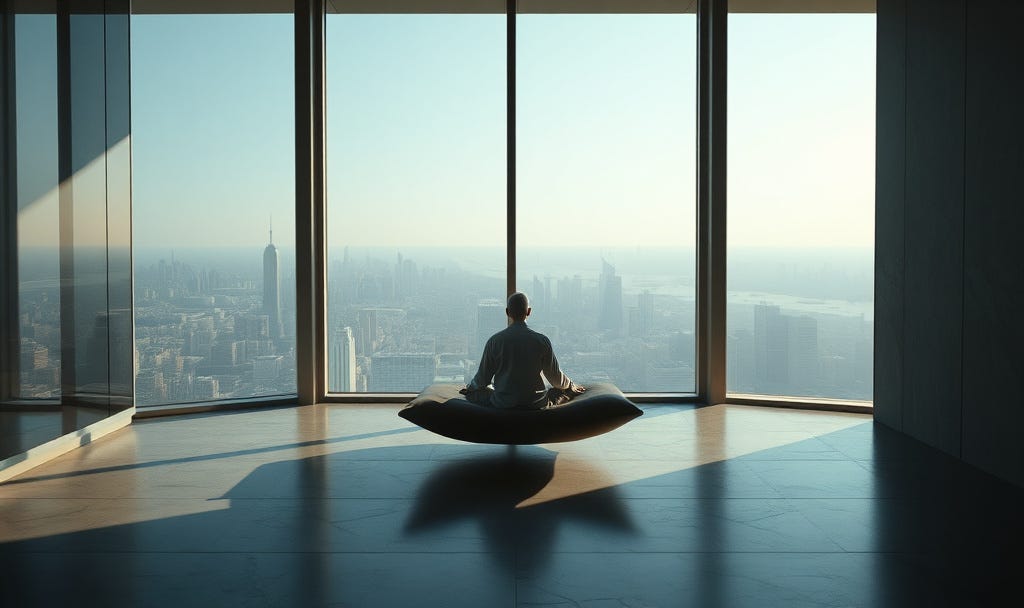
In Buddhism, meditation is introduced as a means to reach enlightenment. It cannot achieve that.
THE PARADOX AT THE HEART OF THE PRACTICE
Buddhism teaches that suffering is sustained by desire — the endless grasping for pleasure and avoidance of pain. The path to freedom is the dissolution of that grasping. What remains when desire falls away is awakening.
But here is the problem: every single time someone sits down to meditate, they do so because they want something. Peace. Relief. Clarity. Freedom from suffering. The practice is initiated, sustained, and measured by the very mechanism it is trying to dissolve. There is no fundamental difference between meditation and doing sport, meeting friends or any other activity we repeat, that is beneficial to our health and well-being.
The ego is attempting to eliminate the ego. Desire is being used as the instrument to end desire.
This is not a philosophical footnote. It is a contradiction built into the heart of the practice. The most committed meditators felt this tension acutely — which is why so many removed themselves from ordinary life entirely, into monasteries, to minimise the forces feeding the very pattern they were trying to escape.
Even with that level of dedication, for most practitioners the goal remains perpetually just ahead. This flaw is what we need to solve to unlock consciousness and sustain inner peace.
THE DEAD DOG IN THE RIVER
A few years ago, I had lunch with an old French billionaire — a now retired man who had built two companies entirely from scratch, selling the first for a billion dollars, the second for half that, owning a hundred percent of both. There was nothing left for him to prove, and nothing he needed to sell. He just talked.
I asked him the obvious question: what had made him successful.
“The dead dog in the river,” he said.
The statement worked, I was puzzled.
“Even the dead dog in the river finds the sea.” He had learned early to recognise which currents were already moving — which technologies, which shifts, which forces were driving society — and to position himself within them rather than against them. He did not generate the momentum. He found it, and flowed with it.
That image stayed with me. And when I looked at meditation through that lens, something became clear: the practice is asking the mind to swim upstream — to use effort, self-directed will to dissolve the very structure that generates effortful, self-directed will. It is working against the current.
What if there was a way to work with it instead?
WHAT MEDITATION IS ACTUALY POINTING AT
The moments of genuine stillness I have found in practice — and that researchers now measure in advanced meditators, in psychedelic therapy, in near-death experiences — are not illusions. They are specific, reproducible brain states. High complexity, high entropy patterns of neural activity. The Default Mode Network quiets. The simulation drops. And what people consistently report, across cultures and centuries, is the same: time dissolves, the boundary of self softens, suffering lifts, and what remains is a sense of presence and clarity that is more real than ordinary waking life.
This is what Christianity calls the Kingdom of God within. What Hinduism calls the lifting of Māyā — the veil of illusion — to reveal Satya, the truth beneath. What Buddhism calls Nirvana.
Einstein, who spent his life chasing the deep structure of reality, described wanting to know the mind of God. Stephen Hawking suggested that a complete theory of the universe would let us do exactly that. Quantum physics has since revealed that at the foundation of matter, reality is fields, energy and probabilities, shaped by observation itself.
The deeper science goes, the more it converges on what contemplative traditions have always described: that consciousness is not a byproduct of the physical world, but something far more fundamental to it.
The human brain is the most complex structure known we have found in the universe.
Research consistently shows that increasing the complexity of brain activity correlates directly with higher states of consciousness — ego dissolution, timelessness, oneness, relief from mental health disorders, and expanded cognitive capacity.
The destination meditation points toward is not mystical speculation. It is measurable neuroscience. And it is real.
The insight meditation offers is exactly right: the ability to distinguish, moment by moment, between what is being sensed and what is being thought — that distinction breaks the loop. Trauma stops triggering itself. Rumination loses its hold. The brain begins to heal. The flaw is not the destination. The flaw is asking the ego to be the one who gets you there.
THE QUESTION THAT REMAINS
If the brain state is real, measurable, and reproducible — if we know what it looks like, what it does, and what it heals — then the question is no longer whether the destination exists. The question is whether there is a path that does not require the ego’s cooperation to reach it.
Not through belief. Not through years of disciplined practice. Not through chemicals with unpredictable effects. But through something designed, from the outside in, to interrupt the loop at its source.
That is what the final article is about: engineering consciousness.